
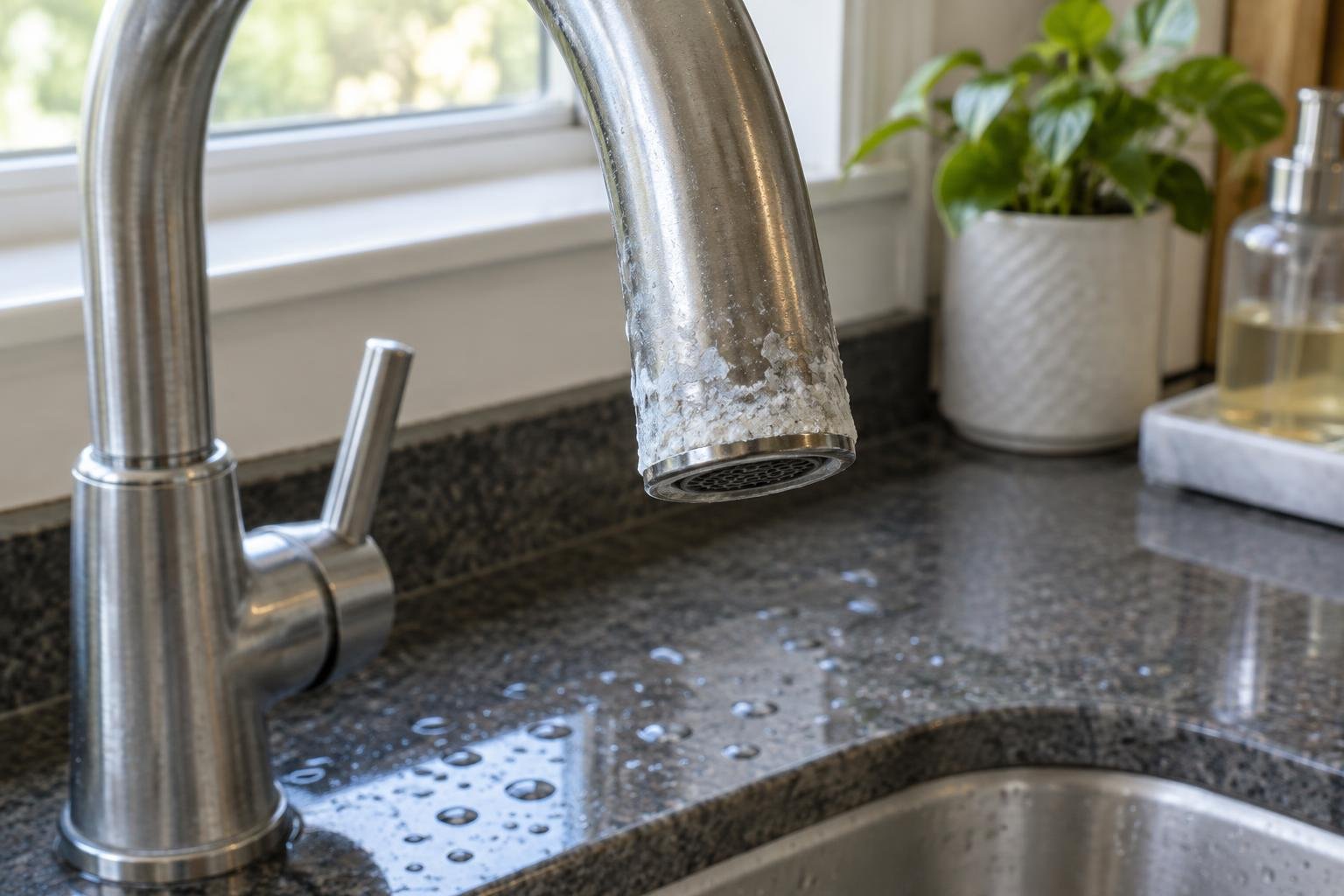
If you've ever pulled a "clean" glass out of the dishwasher and found it covered in cloudy white spots, you already know something's up with your water. That's not a dishwasher problem. That's hard water in Dallas, and it's coming out of nearly every tap in North Texas.
Hard water isn't dirty or unsafe. It's just carrying more dissolved minerals than it should, and those minerals leave a mark on everything they touch — your skin, your clothes, your pipes, and your appliances. Here's what's actually in your water, how hard it really is in the Dallas area, and how to tell if it's costing you more than you realize.
Rain falls soft. But before it reaches your faucet, it travels through soil and rock — and North Texas sits on a lot of limestone. As water moves through limestone and chalk formations, it dissolves calcium and magnesium out of the rock and carries those minerals along with it. That mineral load is what makes water "hard."
None of this is harmful to drink. The issue is what calcium and magnesium do once they're in your plumbing: they don't stay dissolved forever. When water heats up, sits still, or evaporates, those minerals come out of solution and turn into scale — the chalky white buildup you see on faucets, shower doors, and coffee makers.
Water hardness is measured in grains per gallon (GPG) — think of it as a simple count of how many "grains" of dissolved calcium and magnesium are packed into every gallon of water. The higher the number, the more mineral content, and the more scale-forming, soap-fighting behavior you'll notice at home. Water suppliers and testing labs use this scale to sort water into categories:
Anything past the "hard" mark is where homeowners start noticing real problems — not just a little spotting on glassware, but scale buildup that shortens the life of water heaters, clogs faucet aerators, and makes soap and detergent work harder than they should.
Dallas gets all of its water from surface sources: the Elm Fork of the Trinity River and six regional reservoirs, including Lake Ray Roberts, Lewisville Lake and Lake Ray Hubbard. Dallas Water Utilities reports average hardness of roughly 140–160 mg/L, which works out to about 8 to 9 grains per gallon: squarely in the "hard" range on the scale above. Suburbs served by other suppliers draw from different lakes, so your number can differ from Dallas proper and shift with the seasons, but the pattern across North Texas is consistent: this is mineral-heavy water, not the soft water you'd find in parts of the Pacific Northwest or New England.
If you want your exact number instead of a regional estimate, that's the first thing a proper water test tells you — no guessing required.
You don't need a lab to suspect hard water. Your house is already telling you. Look for:
Any one of these on its own isn't proof. All of them together, in a Dallas home, is about as close to a diagnosis as you'll get without a test.
Hard water is easy to normalize because it doesn't announce itself the way a leak or a broken AC does. It just quietly adds cost and wear everywhere at once: more detergent and soap purchased, more frequent appliance repairs, a water heater that runs less efficiently and needs replacing sooner, and pipes that slowly narrow with scale. None of it shows up as one big bill — it shows up as a dozen small ones, spread out over years.
There's also a connection to your home's overall energy use. A scaled-up water heater has to work harder to deliver the same hot water, which shows up on your power bill right alongside the other systems covered in a whole-home energy management plan. If you're already looking at ways to bring your utility costs down, your water heater's efficiency is part of that picture.
Guessing at your hardness level from symptoms is a reasonable start, but it doesn't tell you the whole story. A real water test shows you the specific grains-per-gallon number for your home, plus other things worth knowing about what's coming out of your tap — sediment, chlorine levels, and other water quality factors that vary by neighborhood and by which utility serves your address.
That's the starting point for H2O Clarity by US Home Comfort, our water-quality program built for North Texas homes. Instead of selling you a system based on a regional average, we start with your actual water. From there, the right fix might be a whole-house water filtration system, a dedicated water softener, or a combination — sized to your home's hardness level, not a one-size-fits-all guess.
You don't have to keep wondering how hard your water really is or squinting at spotty glassware for clues. Request a free water report through our whole-home water filtration page and find out your home's hardness reading and what's actually in your tap water — no cost, no obligation, just real numbers for your address.
Once you know what you're working with, cleaner water at every tap is a straightforward fix, not a guessing game. And if you're curious what other homeowners in the area have experienced after making the switch, you can read a few of their stories on our testimonials page or explore more of our completed projects in the US Home Comfort portfolio.