
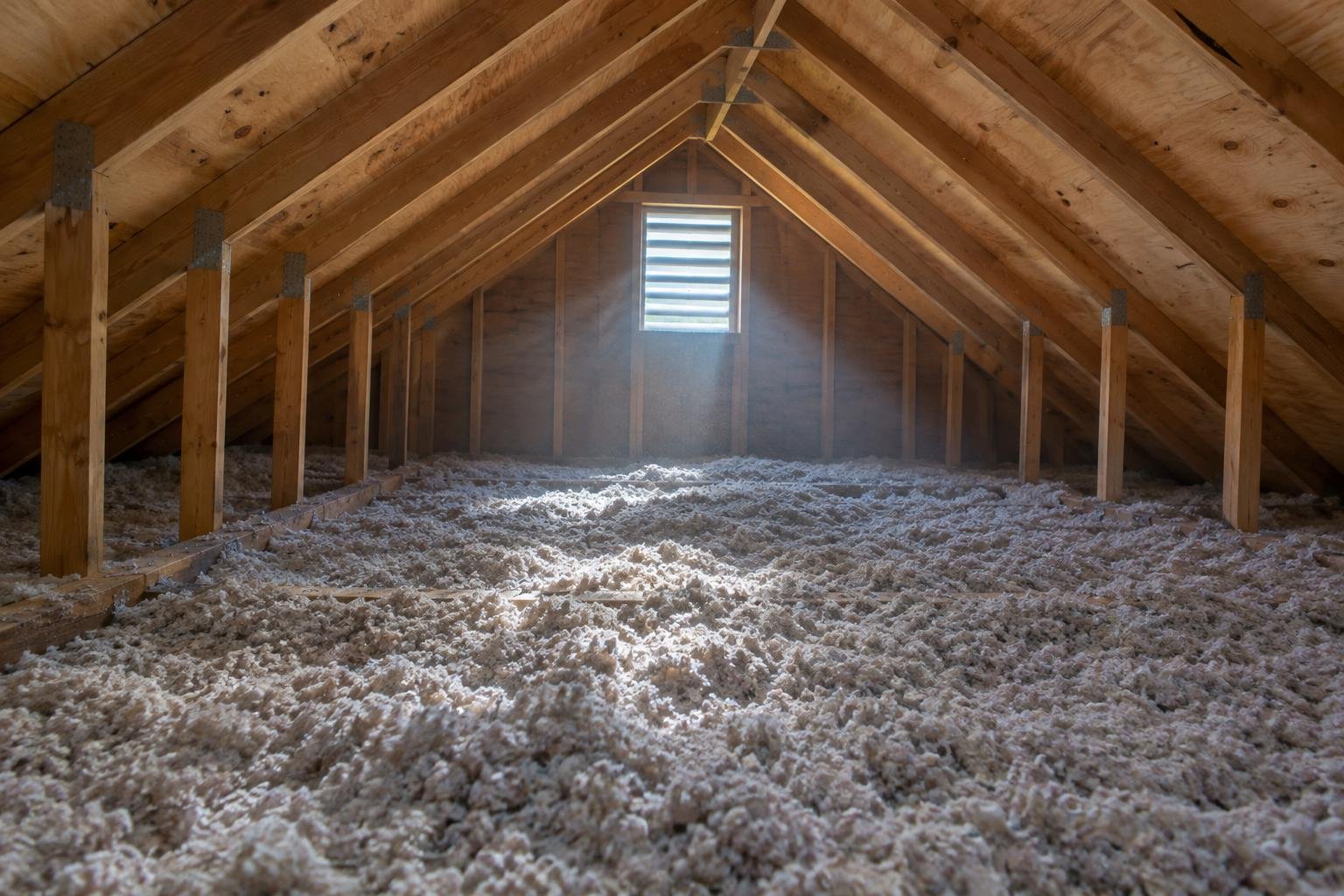
It's 3 p.m. in July. The thermostat downstairs says 74. Upstairs feels like 80, the air handler hasn't shut off since noon, and the August bill is going to sting. Nine times out of ten in North Texas, the problem isn't the air conditioner. It's the attic above it.
Attic insulation in Dallas, TX is the cheapest fix most homeowners never get around to. It doesn't hum, it doesn't need service calls, and it works every hour of every 100-degree afternoon. Here's how much you actually need, how to check what's up there right now, and what changes once you add more.
Federal guidance for our climate zone puts attic insulation somewhere in the R-30 to R-60 range. R-value is simply a measure of how well a material slows heat from passing through it — higher number, slower heat. For a Dallas house that runs the air conditioner five or six months a year, R-38 is a sensible floor and R-49 is a better target.
Translated into something you can measure with a tape:
So when a contractor says "you need R-49," what they mean is a deep, even blanket you can't see the ceiling joists through. If your joists are sticking up out of the insulation like railroad ties, you're short.
A dark composition-shingle roof under full Texas sun pushes attic air far past the outdoor temperature. On a 100-degree afternoon it is normal for a Dallas attic to sit at 130 degrees or hotter. That heat doesn't stay put. It radiates and conducts straight down through the ceiling into your bedrooms all afternoon and well into the evening — which is exactly why upstairs still feels warm at 9 p.m. after the sun is down.
Insulation doesn't stop that heat. It slows it. A deep, even layer means less of that 130-degree attic lands in your living space, so the system cycles off instead of running flat out. That's also why insulation is a year-round fix: the same layer that holds summer heat out holds furnace heat in come January.
You don't need a contractor to answer the first question. Go up early in the morning before the attic heats up, stay on the decking or the joists, and take a tape measure.
If you measure less than 8 inches of anything, you're well below where a Dallas home should be. Between 8 and 12 inches, there's meaningful room to improve. Over 15 inches and reasonably even, your money is probably better spent elsewhere.
This is the step most homeowners skip, and it's the one that makes the insulation worth paying for. Insulation slows heat moving through materials. It does almost nothing about air moving through holes. Blowing 16 inches of fiberglass over an unsealed ceiling is like putting a sweater on over a window that's cracked open.
Before anything gets blown in, the penetrations through your ceiling plane should be sealed: top plates, plumbing and wiring chases, the attic hatch, recessed light housings, bath and kitchen vents, and the gap around the chimney or flue (with the correct fire-rated materials). Seal first, insulate second. The combination is what steadies the temperature between floors.
This is the standard answer for most existing Dallas homes, and for good reason. It's installed from a hose, so it flows over wiring, around obstructions and into the awkward corners that batts never cover well. It's the least expensive way to get real depth, and it can usually be added on top of what's already there — assuming what's already there is dry and in decent shape.
Blown-in keeps the attic vented: outside air still moves through the soffit and ridge vents, and your insulation sits on the attic floor. The ductwork and air handler stay outside the conditioned envelope, up in that hot air. If your ducts are leaky, that's a limitation worth knowing about.
Spray foam applied to the underside of the roof deck does something different: it moves the insulation boundary from the attic floor up to the roofline and brings the whole attic inside the conditioned part of the house. Your ducts and air handler are no longer baking at 130 degrees. Foam also air seals as it goes, which is a real advantage in a complicated attic.
The trade-offs are honest ones. Spray foam costs substantially more per square foot. It changes how the attic breathes, so ventilation, combustion appliances and moisture all have to be planned for correctly. And it's not a weekend add-on — it's a project.
Here's the honest version: nobody can quote you a dollar figure sight unseen. Your bill depends on your rate plan, your square footage, the age and efficiency of your system, your duct condition, your windows and how low you set the thermostat. Anyone promising an exact number hasn't seen your attic.
What you can count on is a change in behavior. A properly sealed and insulated attic means less heat arriving at your ceiling, which means shorter run times, fewer long afternoon cycles, and a system that actually reaches setpoint instead of chasing it. Cooling is usually the single largest line on a North Texas summer bill, so reducing run time is where the money is. Most homeowners notice the comfort difference first — upstairs stops being the room nobody wants to sleep in — and the bill difference over the following billing cycles.
Insulation also makes everything else you do work better. A new high-efficiency system in a leaky attic is an expensive way to cool the neighborhood. If your bills have been climbing and you're not sure why, our breakdown of why Texas electric bills run so high — and what actually fixes them walks through the other usual suspects.
Measure what you have. If it's under a foot, uneven, or sitting over an unsealed ceiling, you have a clear and affordable improvement waiting. See how we handle attic insulation and air sealing for Dallas homes, or look at how insulation fits alongside the rest of your home energy management in Dallas — the systems work better together than any one of them does alone.
And while you're making the house work harder for you: North Texas tap water is hard enough that it shortens the life of water heaters and fixtures. You can request a free Dallas water report and whole house water filtration assessment at the same time. One visit, a clearer picture of the whole house.