
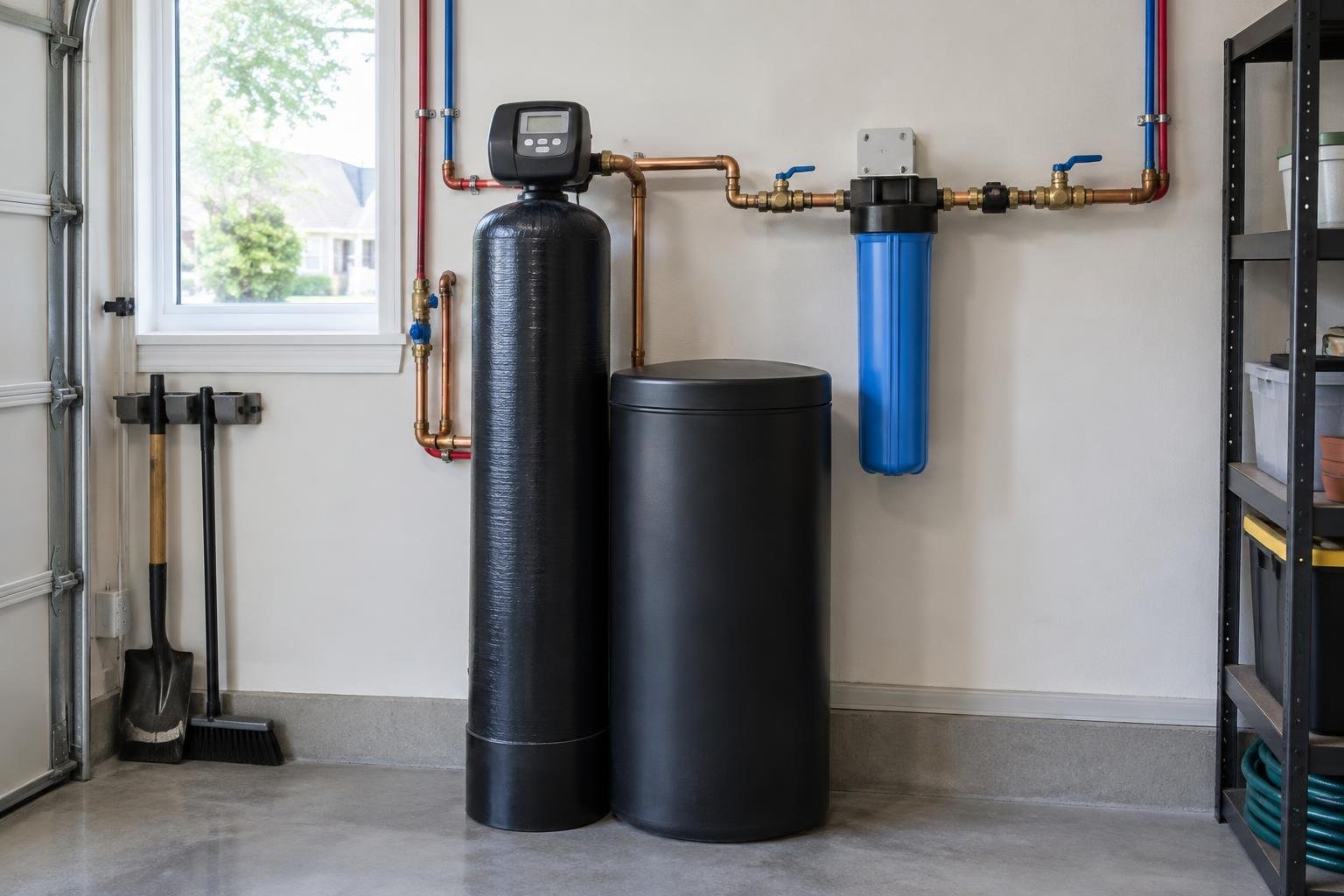
Spotty glassware. A film on the shower door you can scrape with a fingernail. Water that tastes faintly of the pool. Most Dallas homeowners notice one of those things, start shopping, and immediately hit the same wall: whole house water filter vs water softener — which one actually fixes it?
They are not the same machine, and they do not solve the same problem. A softener deals with hardness. A filter deals with taste, odor and contaminants. Buy the wrong one and you will still be unhappy six months later. Here is the plain-English breakdown, what each costs to own, and when a North Texas home genuinely needs both.
If your complaint is scale — crusty faucets, cloudy dishes, soap that won't lather, appliances wearing out early — you need a water softener.
If your complaint is taste, smell or what's dissolved in the water — chlorine, that swimming-pool note, sediment, general "I don't drink from the tap" unease — you need a whole house water filtration system.
Plenty of Dallas homes have both complaints. That is why combined systems are common here, and why we always start with a test instead of a guess.
Hard water simply means the water carries dissolved calcium and magnesium. Those minerals are picked up as water moves through limestone and soil, and North Texas has plenty of both. Hardness is usually measured in grains per gallon — a lab measure of how much dissolved mineral is in the water. The higher the number, the faster scale builds.
A softener runs your water through a tank of resin beads that hold onto sodium or potassium. The calcium and magnesium stick to the beads, and the sodium or potassium releases into the water. When the beads fill up, the system rinses itself with a brine solution from a salt tank and starts over. That rinse cycle is why softeners need salt refilled.
A softener is a mineral machine, not a purifier. It makes your water gentler on your house. It does not make it taste better.
A whole house filter — sometimes called a point-of-entry system — installs where the main water line comes into your home. Everything downstream gets treated: kitchen, bathrooms, laundry, hose bibs.
Most systems use layers. A sediment stage catches grit and rust. A carbon stage grabs chlorine and the compounds behind odd tastes and odors. Depending on what your water report shows, additional media can target specific contaminants. Some homeowners add a dedicated drinking-water stage at the kitchen sink for the final polish.
This is the mistake we see most often in Dallas homes. A homeowner installs a good filter, the water tastes excellent, and the shower door still films over within a week. The filter did its job. It just was not the job that needed doing.
We are not going to throw a price at you in a blog post, because the honest answer depends on your water test, your household size and how your plumbing is laid out. A two-person townhome in University Park and a five-bedroom house in Garland with two water heaters are different projects. What we can tell you is how the money behaves over time.
You pay once for the equipment and installation, then you pay a little forever. Salt is the recurring cost — a bag every few weeks to a few months depending on how hard your water is and how much you use. Modern metered systems regenerate based on actual water use instead of a timer, which cuts salt and water waste. Resin lasts years, then eventually needs replacing. Beyond that, maintenance is mostly keeping the salt tank full and watching for a crusted salt bridge.
Same shape: upfront equipment and install, then periodic media or cartridge replacement. Sediment pre-filters get changed most often. Carbon media lasts considerably longer but does wear out — and a spent carbon stage quietly stops working without any obvious signal, which is why service intervals matter more than they seem. Put the replacement on a calendar or a service plan.
Untreated hard water has a price too. Scale is an insulator. A water heater with a scaled element or heat exchanger burns more energy to deliver the same hot shower, and it fails earlier. Add dishwashers, washing machines, ice makers, coffee makers, faucet cartridges and detergent you use more of than you need to. Nobody gets a line-item bill for that, which is exactly why it is easy to ignore.
Dallas drinking water is treated surface water from area lakes and reservoirs. Treatment does its job on safety, and that treatment includes disinfectant you can often taste. Meanwhile the water still carries the dissolved minerals it collected before it ever reached the plant. So a typical North Texas home is dealing with two separate issues at once: hardness and taste.
That is the case for a combined setup — a filter at the point of entry, a softener behind it. Order matters. Filtering first protects the softener's resin from chlorine, which shortens resin life over time. Done right, one system handles taste and odor and the other handles scale, and you stop troubleshooting your water.
Consider both if you recognize several of these:
Only need one? That happens. Some homes are mostly fine on taste and just need scale control. Others have soft-enough water and a chlorine problem. Sizing one system correctly beats installing two badly.
Every recommendation in this post depends on one thing we do not know yet: what is in your water. Hardness varies across the metroplex, and homes on different supply lines can test differently a few miles apart. Guessing is how people end up with equipment that does not match the problem.
H2O Clarity by US Home Comfort is our water-quality program, and it begins with a free water report for your Dallas home. You get your hardness in plain numbers, what the treatment chemistry looks like at your tap, and a straight recommendation — softener, whole house water filtration, or both — sized to your household instead of a catalog.
Want the background first? Read how hard Dallas water really is to see what is coming out of your tap before you shop. And if you are already weighing other upgrades, our full range of home comfort services across Dallas covers water, energy and insulation under one roof — or just reach out and ask us a question.
Cleaner water at every tap, and a house that stops fighting its own plumbing. That is the whole point.