
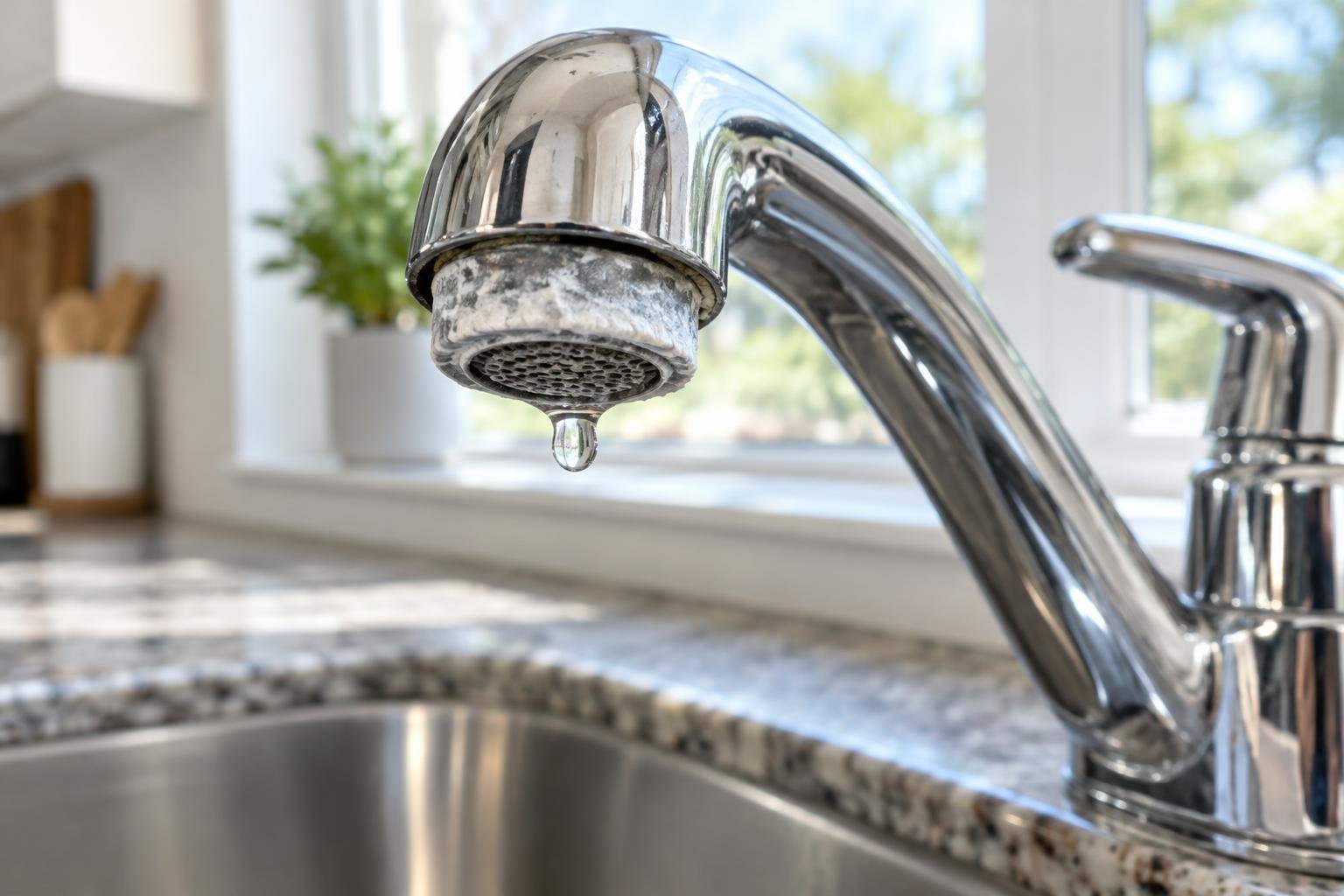
Spots on the glasses. A white crust on the shower head. A water heater that starts popping and rumbling about year six. Those are not coincidences — they are the daily receipts for Dallas water hardness, and the number behind them is different depending on which utility fills your pipes.
Here is what hardness actually means, how to find the real figure for your own address in Dallas, Plano, Frisco, Garland and the rest of North Texas, and what each level does to fixtures, water heaters and laundry over time.
Hard water is water carrying dissolved calcium and magnesium. It picked them up from limestone and soil before it ever reached a treatment plant. Those minerals are not a health hazard. They are a plumbing and appliance problem, because when hard water is heated or left to evaporate, the minerals drop out and stick to whatever they touch.
Hardness is measured two ways, and you will see both:
Converting is simple: divide milligrams per liter by 17.1 to get grains per gallon. So 150 mg/L is about 8.8 grains. 200 mg/L is about 11.7 grains.
Most of the DFW area lands in that moderately hard to hard band. That is the short answer to "does Dallas have hard water" — yes, and it is hard enough to cost you money, but not so hard that you can see it in the glass.
North Texas drinks surface water. Lakes and reservoirs, not deep wells. That matters for two reasons: the hardness number depends on which lakes your utility is pulling from this season, and it shifts through the year with rainfall, drought and blending.
So anyone who hands you one permanent number for "Dallas water hardness" is oversimplifying. What you can know is which system serves you and roughly where it sits.
Dallas runs its own treatment plants and draws from a group of regional reservoirs, blending among them depending on supply. Because the blend changes, hardness at a Lakewood tap in March and a Preston Hollow tap in September are not guaranteed to match. Dallas Water Utilities also wholesales treated water to a number of surrounding cities, so if you live in a suburb that buys from Dallas, your water story is Dallas's story.
These are member cities of the North Texas Municipal Water District, which treats water at a regional scale and distributes it to its members. Within that system, neighboring cities tend to run close to one another — Plano and Frisco will generally look more like each other than either looks like a city on a different supply. Garland and Richardson sit in the same family.
That is why "Frisco water hardness" and "Plano water hardness" searches usually land on similar answers. Same source, same treatment, slightly different distribution distance.
Irving and several Dallas-adjacent cities purchase treated water wholesale. Fort Worth and Arlington run on a different set of reservoirs through the Tarrant Regional Water District. Different source, different mineral profile, still firmly in hard-water country.
Every public water system in Texas publishes an annual water quality report — you will also see it called a Consumer Confidence Report. It is free, it is public, and it is usually linked from your city's utility billing page.
One caution: that report describes water leaving the plant and moving through the mains. It does not describe what is coming out of your kitchen faucet after it has traveled through your service line, your home's plumbing and whatever is sitting in your water heater. For that, you need a sample from your own tap. We cover the difference in detail in what a free water test actually tells you about your Dallas tap water.
Hardness does not break anything on a Tuesday. It taxes everything, slowly.
This is where hardness costs the most. Heat drives minerals out of solution, and they settle in the bottom of a tank water heater as scale. That layer sits between the burner and the water, so the heater runs longer to hit the same temperature. Popping and rumbling noises are steam escaping from under the scale bed. In a tankless unit, the same minerals coat the heat exchanger and can trigger error codes or flow faults if the unit is not descaled on schedule.
At moderate hardness, you are looking at periodic flushing. At 7 to 10 grains and above, skipping maintenance meaningfully shortens the life of the appliance.
The crust on the shower head is the visible part. The invisible part is the aerator screens, the valve cartridges and the fill valves in your toilets, all collecting the same deposits. Scale is also why a shower head slowly loses pressure and sprays sideways.
Those cloudy glasses are mineral film left behind as water evaporates. At moderate hardness, a rinse aid handles most of it. At hard levels, it comes back no matter how much detergent you add — because detergent is being spent neutralizing minerals instead of cleaning.
Hard water is why towels feel stiff and whites go gray. Minerals bind with detergent and deposit in the fabric instead of rinsing away. Households on hard water typically use noticeably more detergent to get the same result.
The slick film after a shower is soap scum — soap reacting with calcium and magnesium rather than rinsing clean. Plenty of Dallas homeowners who assume they have sensitive skin are actually reacting to the residue.
Here is the part most hardness articles skip. Hardness explains scale and laundry. It does not explain taste, chlorine smell, sediment, or iron staining — and "dallas water iron conditioning" is a real search for a reason, because iron leaves orange-brown marks in sinks and laundry that no softener alone was designed to address.
That is why the right equipment depends on what you actually have:
Buying a softener for a taste problem, or a filter for a scale problem, is how homeowners end up spending money twice.
Your city's report tells you what the system delivers. A test at your sink tells you what your household is living with — hardness in grains per gallon, plus what else is riding along with it.
H2O Clarity by US Home Comfort gives Dallas-area homeowners a free water report based on your address and your tap. No obligation, no pressure. You get the numbers, an explanation of what each one means for your fixtures and appliances, and a straight answer about whether equipment is worth it for your home.
Request your free water report and see what whole house water filtration would do for your Dallas home — then decide with real information instead of guessing from the spots on your glassware.