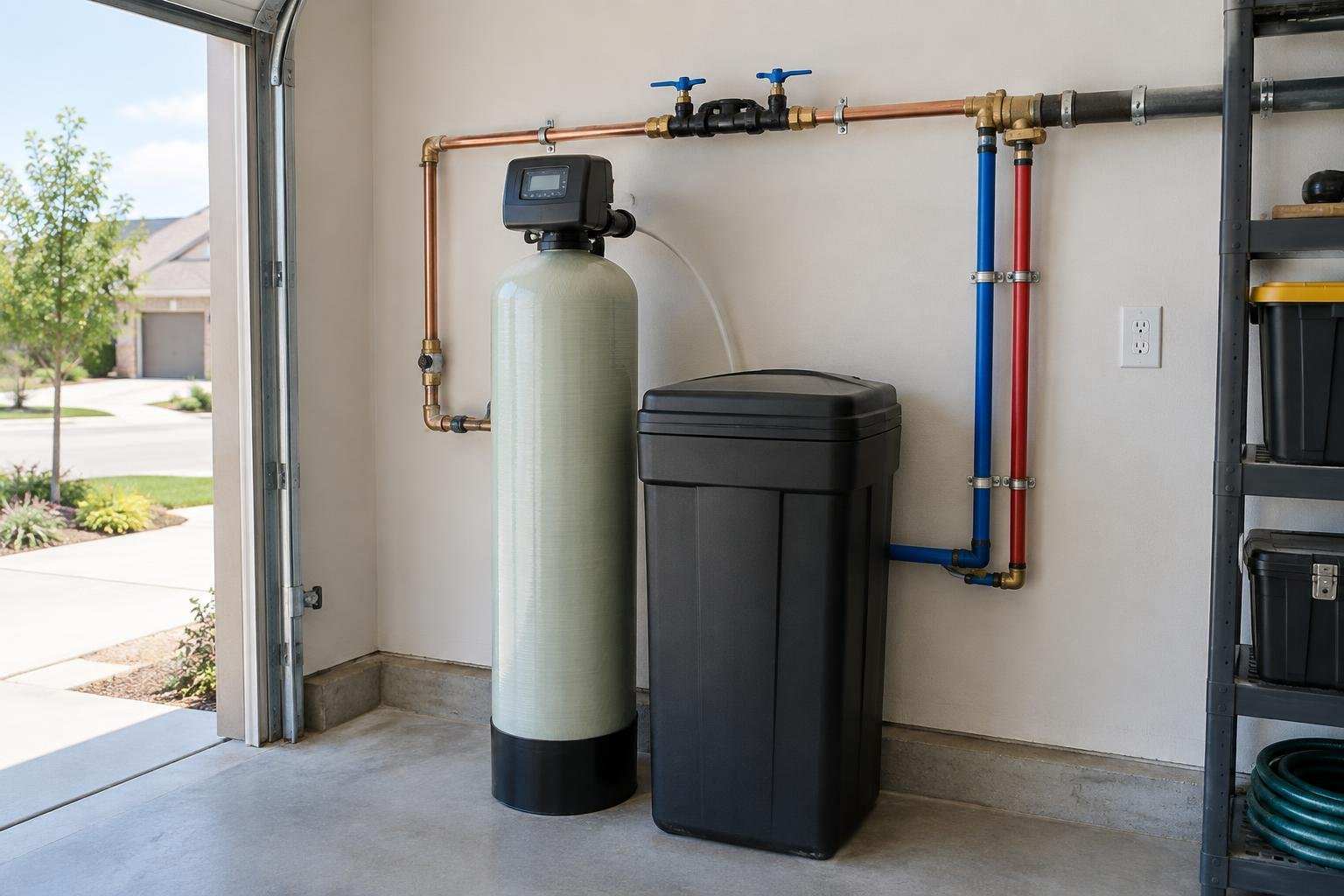
Ask three companies about whole house water filtration Dallas cost and you can get three wildly different numbers. One quotes $1,800. One quotes $7,500. Both call it "a whole house system." Neither explains why the gap is so wide.
Here's the honest version. The price of a water filtration system in Dallas, TX depends on four things: what you're actually treating for, how much water your household uses, what equipment you choose, and how hard it is to tie the system into your plumbing. This post walks through realistic price ranges, what should be included in a proper install, and what you'll spend every year to keep it running. No savings promises, no vague "call for pricing."
The short answer: typical installed price ranges
These are the ranges homeowners commonly see across the Dallas–Fort Worth market for professionally installed equipment. Your quote can land outside them for good reasons, which we cover below.
- Whole house carbon filtration (point of entry): roughly $1,500–$4,000 installed. Reduces chlorine taste and odor, sediment and many common contaminants at the main line.
- Water softener (ion exchange, salt-based): roughly $1,500–$3,500 installed. Treats hardness minerals — the calcium and magnesium that leave scale on fixtures and inside water heaters.
- Combination filtration + softening system: roughly $3,000–$6,500 installed. Two tanks, or one hybrid unit, handling taste and hardness together.
- Salt-free conditioner ("descaler"): roughly $1,200–$3,000 installed. Changes how hardness minerals behave so they're less likely to stick, but does not remove them.
- Under-sink reverse osmosis for drinking water: roughly $400–$1,500 installed. Often added to a whole-house system rather than replacing it.
- Well water treatment (iron, sulfur, bacteria, sediment): $4,000 and up, because it usually takes multiple stages plus testing.
If a quote is far under the low end, find out what's missing — usually labor, a bypass valve, or a drain line. If it's far over the high end, ask which specific problem in your water justifies the extra equipment.
Why Dallas water changes the math
Dallas-area water is treated and safe to drink, but it isn't soft. Most North Texas homes see moderately hard water, which is why you get spots on glassware, crust on shower heads, and soap that never quite rinses off. If you want the details on what's coming out of your tap, we broke it down in how hard Dallas water really is.
Hardness is measured in grains per gallon — plain English: how much dissolved mineral is riding along in your water. The higher that number, the bigger the softener you need and the more salt it uses. That's a cost driver before anyone touches a pipe.
The second driver is taste and smell. Municipal systems add a chlorine-based disinfectant to keep water safe on its way to your house. That's a feature, not a flaw, but it's also why a lot of Dallas homeowners want carbon filtration. Filtration and softening solve different problems, and plenty of homes need both. We compared them side by side in whole house water filter vs. water softener.
Cost by home size and household use
Equipment gets sized by how much water your household runs through it per day and how hard that water is — not by square footage alone. Still, home size is a decent shorthand because bigger homes usually mean more bathrooms and more people.
Small homes and condos (1–2 bathrooms, 1–3 people)
A compact carbon system or a smaller-capacity softener usually covers it. Expect the lower third of the ranges above. Installs tend to be simpler because there's less plumbing to reroute.
Mid-size Dallas homes (3–4 bathrooms, 3–5 people)
This is the bulk of the market. Most families here land in a combination system, roughly $3,000–$5,500 installed, sized so the unit isn't regenerating constantly or running out of capacity during morning showers.
Large homes (5+ bathrooms, high demand, irrigation tie-ins)
Bigger tanks, larger valves, and sometimes twin-tank equipment so treated water is always available. Expect $5,000 and up. Undersizing a large home is the most common mistake we see — it looks cheaper on the quote and disappoints every day after that.
What actually drives your price up or down
- Where the main line is. A garage with an accessible main and a floor drain is the easy case. A tight utility closet, an attic run, or an exterior install that needs freeze protection costs more in labor and materials.
- Drain access. Salt-based softeners need somewhere to send regeneration water. If there's no drain nearby, that's added plumbing.
- Electrical. Most metered systems need a standard outlet within reach. Adding one adds cost.
- Slab construction. Common across Dallas. It limits where pipe can be rerouted and can push the install outside or into the garage.
- Loop or no loop. Many newer North Texas homes were plumbed with a water-softener loop. If yours has one, the install is faster and cheaper. If it doesn't, the plumber has to create the tie-in.
- Valve and media quality. The control valve is the part that does the work and the part that fails first on cheap systems. Better valves and better filter media cost more up front and last longer.
- Add-ons. Sediment pre-filters, UV treatment, drinking-water reverse osmosis, or a dedicated line to the refrigerator each add to the total.
- Permits and code. Requirements vary by city across DFW. A licensed installer should know what your municipality expects.
What a complete install should include
When you compare quotes, compare what's in them. A proper whole house water filtration install in Dallas should cover:
- Water testing first. Hardness, chlorine, iron, pH, total dissolved solids. Sizing without testing is guessing.
- Correctly sized equipment for your household's peak demand, not a one-size-fits-all box.
- The tie-in at the main line so every tap, shower, and appliance is covered.
- A bypass valve. Non-negotiable. It lets you service the system or take it offline without shutting down water to the house.
- Drain line and air gap for salt-based systems, done to code.
- Shut-offs, fittings, and pressure check so you don't lose flow at the shower head.
- Startup, programming, and sanitizing of the new equipment.
- A walkthrough covering salt, filter changes, and what the display is telling you.
- Written warranty terms on both the equipment and the labor — they're usually different lengths.
You can see the scope of work we handle on the Dallas whole house water filtration page, and browse other home comfort work in our project portfolio.
What maintenance costs per year
Filtration isn't install-and-forget. Budget for it honestly up front so it isn't a surprise in year two.
- Salt for a softener: roughly $70–$200 per year depending on hardness and household size. Harder water and more people mean more regenerations.
- Sediment pre-filter cartridges: about $40–$150 per year, typically changed every 3–6 months.
- Carbon media replacement: $300–$900, but not annually — most tank-based carbon media runs several years before it needs to be changed out. Spread over its life, that's often under $150 a year.
- Reverse osmosis filters and membrane: roughly $80–$200 per year for filters, with the membrane replaced less often.
- UV lamp, if you have one: about $100–$200 per year.
- Annual service visit: $100–$250 if you'd rather not handle it yourself.
For a typical Dallas home with a combination system, plan on somewhere between $150 and $400 a year in consumables. Skipping maintenance is what turns a good system into a bad one — a clogged pre-filter drops your water pressure, and exhausted carbon stops doing anything at all.
How to compare quotes without getting talked into extra equipment
- Get your water tested before you shop, and ask each company to size to those results.
- Ask for the brand and model of the control valve and tank, not just "premium system."
- Ask what the system does not treat. A softener won't fix chlorine taste. A carbon filter won't stop scale.
- Get annual maintenance costs in writing alongside the install price.
- Be wary of high-pressure, same-day-only pricing. Good equipment is still good equipment next week.
Water is one piece of how a house feels to live in. If you're already looking at comfort and operating costs, insulation and residential energy management are the other two levers worth understanding.
Start with your numbers, not ours
Every quote in this post is a range because every house is different. The only way to know your real cost is to know your water.
H2O Clarity by US Home Comfort starts every Dallas homeowner with a free water report — what's in your water, how hard it is, and what it would actually take to treat it. No obligation, and no pressure to buy equipment you don't need. If you'd rather talk it through first, get in touch with our Dallas team.