
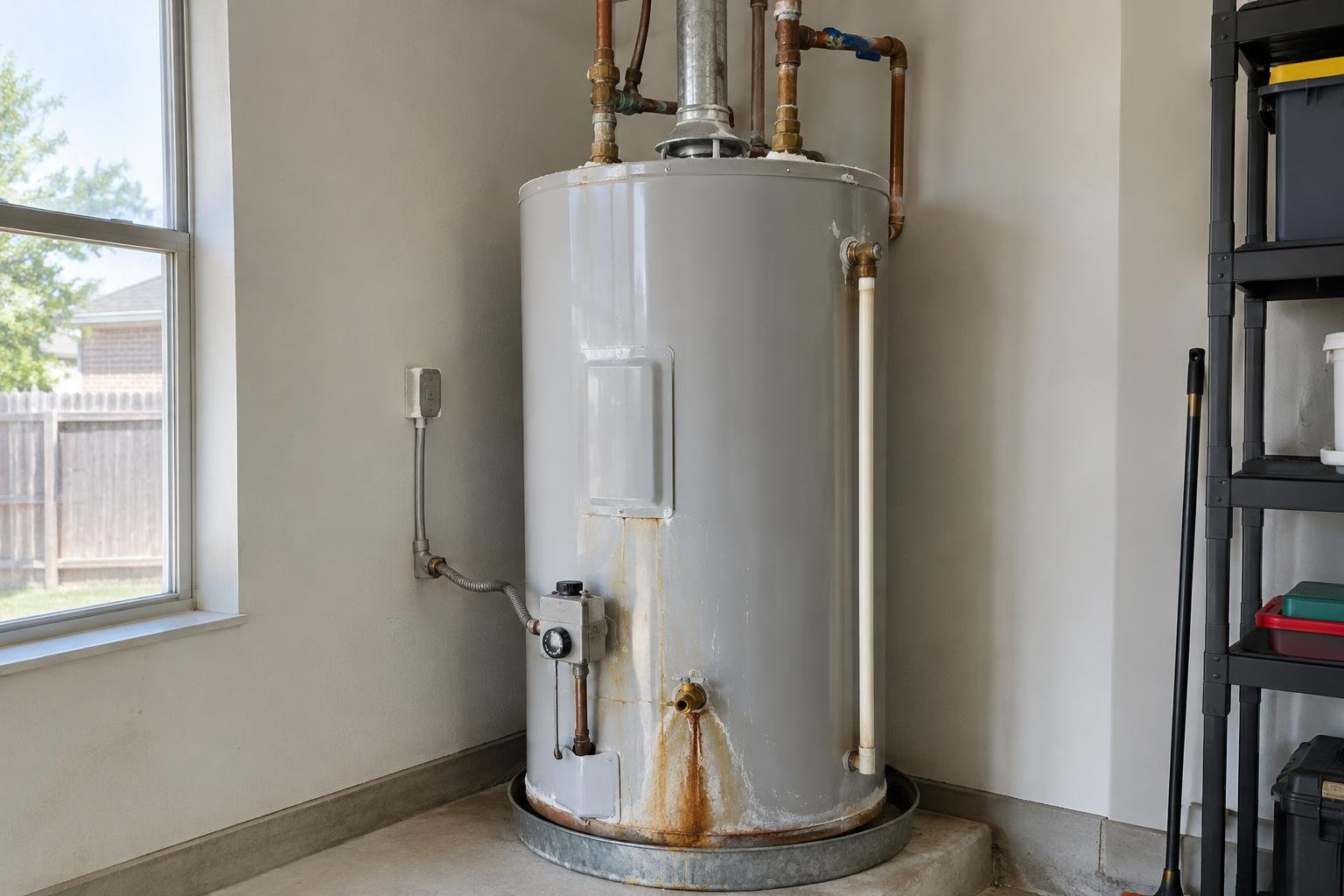
Your water heater is supposed to be boring. It sits in the garage or the attic, it makes hot water, and you forget it exists. Then one morning the shower runs lukewarm, or you find a wet spot spreading across the garage floor, and you're writing a check you didn't plan for.
If that heater was only eight or nine years old, hard water is a likely culprit. Hard water in Dallas is not a rumor or a sales line — it's the normal condition of the water coming out of the tap across most of North Texas. And the appliance that suffers most from it is the one that heats that water all day, every day.
Here's what's actually happening inside the tank, what it costs you on the gas and electric bill before it ever fails, and what softening or conditioning changes.
Hard water is water carrying dissolved minerals — mostly calcium and magnesium — picked up as it moves through limestone. Water hardness is usually measured in grains per gallon, which is just a way of saying how much mineral is dissolved in each gallon. The higher the number, the more mineral your plumbing and appliances have to deal with.
North Texas water comes largely from surface reservoirs sitting on limestone-heavy ground, and it arrives at the tap carrying those minerals. Levels vary by which treatment plant and which lake serves your address, so the water in Preston Hollow isn't identical to the water in Frisco. If you want the detail for your own neighborhood, we broke it down in Does Dallas Have Hard Water? Here's the Straight Answer and in our city-by-city hardness comparison for Dallas, Plano, Frisco and McKinney.
The key point for this article: those minerals stay dissolved while the water is cold. Heat changes that.
When you heat hard water, calcium and magnesium drop out of solution and bond to the nearest hot surface. That's scale — a chalky, stone-like crust. You've seen the soft version of it on a shower head or a faucet aerator. Inside a water heater, it builds in a place you can't see and can't wipe off.
In a standard tank heater, scale collects two ways:
Scale is a poor conductor of heat. That's the whole problem in one sentence. The layer sitting between your burner or element and the water acts like an insulating blanket in exactly the place you don't want one.
On a gas unit, the burner fires under the tank floor. If that floor is coated in scale, the heat can't move into the water efficiently. The steel gets hotter than it was designed to get while the water above it warms slowly. You'll often hear it — popping, rumbling or kettle sounds as water flashes to steam under the sediment layer.
That overheated steel is how glass-lined tanks crack and how the lining fails. Once the lining is compromised, the steel underneath starts corroding, and corrosion in a pressurized tank ends one way: a leak. Tanks aren't repairable. That's a replacement.
Electric units heat with elements submerged directly in the water. Scale coats them like a crust on a baking dish. The element has to run longer and hotter to deliver the same hot water, and a heavily scaled element eventually burns out. Homeowners usually notice it as hot water that runs out faster than it used to — one shower instead of two.
Tankless heaters push water through a narrow heat exchanger at high temperature. There's no tank to hide sediment in, so scale builds in the passages themselves. Flow drops, the unit short-cycles or throws error codes, and the fix is a descaling service — one that has to be repeated regularly on untreated hard water. Plenty of tankless manufacturers are explicit that the unit needs periodic descaling, and some condition their warranty on it. Pull your paperwork and read the exclusions before you assume you're covered.
The failure gets the attention, but the slow cost starts years earlier. A scaled heater has to run longer to produce the same hot water. On a gas unit, that's more therms. On an electric unit, that's more electricity — and water heating is already one of the larger line items in a Texas home's energy use, behind air conditioning.
You won't see a single alarming month. You'll see a baseline that drifts upward year after year and blame the utility. We've written before about the real reasons Texas electric bills run high, and a laboring water heater belongs on that list alongside attic insulation and air leaks. If you're already working on home energy management in Dallas, the water heater deserves a look — it's a device that runs on a schedule you don't control and degrades where you can't see it.
Hard water rarely sends you one big bill. It sends a sequence of smaller ones, and the sequence is predictable:
And it isn't only the heater. The same scale narrows pipe interiors, shortens the life of dishwashers and washing machines, stiffens fixtures and leaves spots on glassware. The water heater just fails first and loudest because it's the appliance doing the heating.
There are two different approaches, and they're not interchangeable.
A softener uses ion exchange — resin beads trade the calcium and magnesium in your water for a small amount of sodium. The hardness minerals leave with the backwash instead of entering your plumbing. Water that reaches the heater has little left to deposit, so scale stops forming. You'll also notice soap lathering properly, less spotting on dishes and glass, and softer laundry. Softeners need salt and they periodically regenerate, so they require a drain and ongoing upkeep.
A salt-free conditioner doesn't remove hardness. It alters the minerals so they're far less likely to stick to hot surfaces and pipe walls — they stay suspended and flow through. Hardness still registers on a test, but scale has a much harder time anchoring itself inside your heater. No salt, no drain, less maintenance.
Whole house filtration targets chlorine or chloramine, taste, odor, sediment and other contaminants. It doesn't remove hardness. Many Dallas homes end up with filtration plus softening or conditioning because they solve different problems. We lay out the difference in Whole House Water Filter vs Water Softener — worth reading before you buy anything, so you don't pay for the wrong box.
Nobody should buy a softener, conditioner or filtration system without knowing what's in their water first. That's why H2O Clarity by US Home Comfort starts every home with a free water report — your actual hardness and water quality for your address, explained in plain language, with no obligation to buy anything.
From there the decision gets simple. If your water is hard enough to be coating the inside of your heater, you'll know, and you'll know whether softening, conditioning or whole house water filtration in Dallas is what your home actually needs. Request your free water report and find out what your water is doing to the appliance you depend on most.