
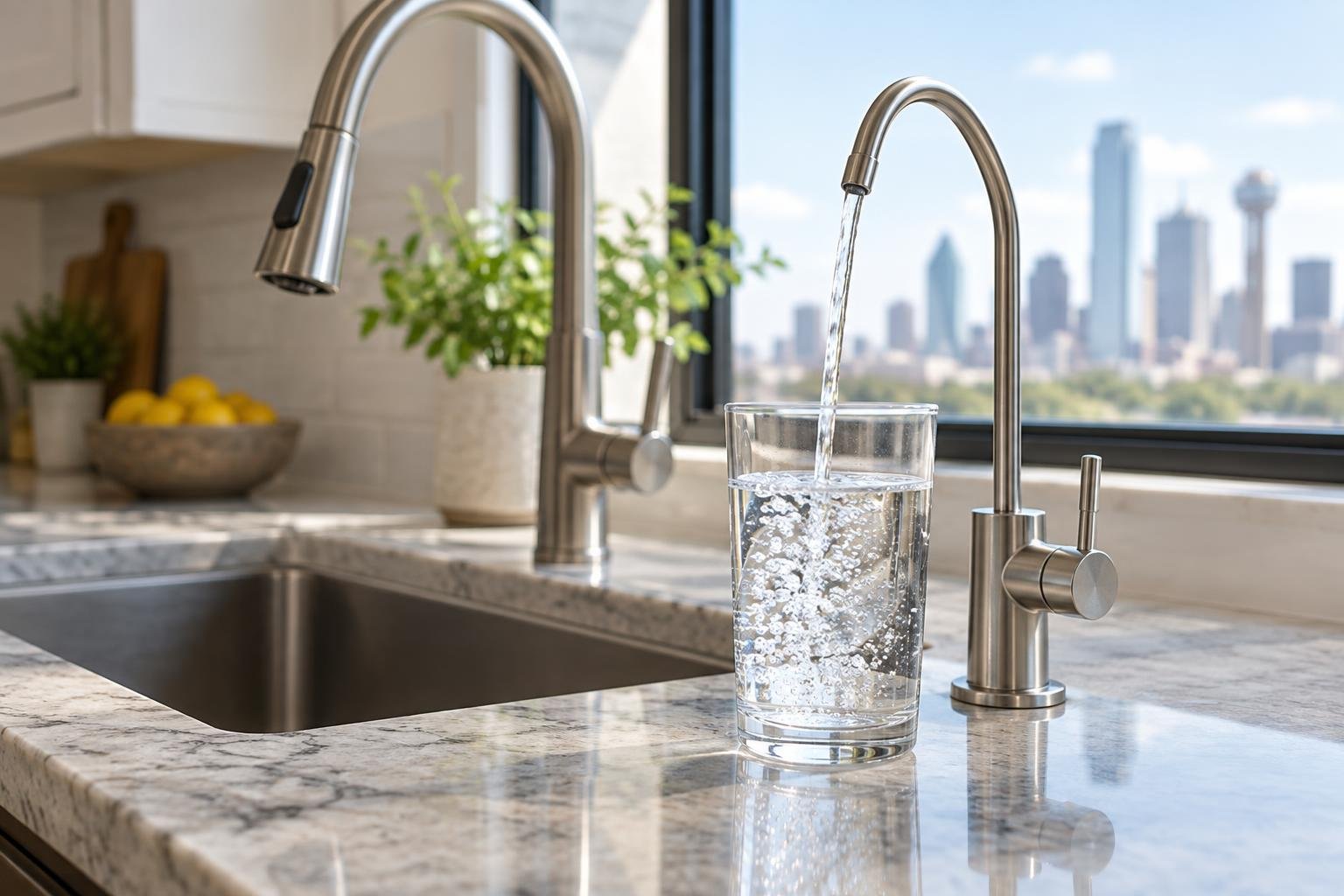
Most Dallas homeowners comparing a whole house water filter vs reverse osmosis are comparing two things that do different jobs. A whole house filter treats every tap — showers, laundry, ice maker, kitchen sink. Reverse osmosis treats one tap, usually the one at your kitchen sink, and treats it much more aggressively.
Here's the plain answer. If your complaint is chlorine smell, dingy laundry, dry skin after a shower, or scale on fixtures, start with the whole house filter. If your complaint is drinking water that still tastes flat or you want the broadest possible reduction of dissolved contaminants in the water you cook with and drink, add reverse osmosis at the sink. Plenty of Dallas homes end up with both, and that's not overkill — it's the two systems covering different ground.
The rest of this post explains what each one actually removes, what it doesn't, and how to decide without guessing.
A whole house system — sometimes called point-of-entry — installs where the city water line comes into your home, usually near the main shutoff or in the garage. Everything downstream gets filtered water: every shower, every faucet, the dishwasher, the washing machine, the water heater, the hose bib if it's plumbed after the unit.
Reverse osmosis is point-of-use. The unit lives under a sink or in a basement-style utility space, pushes water through a membrane with pores small enough to block most dissolved minerals and chemicals, and stores the finished water in a small tank. You get it from a dedicated faucet, and often a line run to the refrigerator for ice and chilled water.
That difference in scope drives everything else: what they remove, what they cost, how often you service them, and whether you need one or both.
A typical whole house setup in North Texas is a sediment stage followed by a carbon stage, sized to your home's flow so showers don't lose pressure. Some systems add specialty media for specific issues found in your water.
What it handles well:
What it does not do:
If you want the real numbers on sizing and installation for a Dallas home, we broke that down in what a whole house water filtration system costs in Dallas.
Reverse osmosis forces water through a membrane under household pressure. Water molecules pass. Most of what's dissolved in the water does not. The rejected portion goes down the drain, which is why RO units use some water to make water.
What it handles well:
What it does not do:
Find the line that sounds like your house.
This is the piece people miss. Dallas-area water is moderately hard — there are real calcium and magnesium minerals dissolved in it, and they land on your fixtures, in your water heater, and on your shower glass. We walked through the actual numbers in how hard Dallas water really is.
Neither of the two systems in this comparison is a hardness solution for the whole house. Reverse osmosis does strip hardness minerals, but only in the gallon or two sitting in that under-sink tank — it does nothing for the water heater or the shower. A standard whole house carbon filter leaves hardness alone by design.
So in a lot of Dallas homes, the right build is three parts, not two: softening or conditioning for scale, whole house filtration for chlorine and sediment at every tap, and reverse osmosis at the kitchen for drinking and cooking. Which parts you actually need depends on your water, your plumbing, and what's bothering you.
Both systems need service, and anyone who tells you otherwise is selling.
Factor service into the comparison. A system that's cheaper up front and expensive to maintain isn't cheaper.
Everything above depends on one thing: what's actually in your water. Dallas-area supply isn't uniform — it varies by neighborhood, by which treatment plant serves you, and by what your own plumbing adds on the way to the tap. A home in the Park Cities and a home in Frisco can have genuinely different starting points.
That's why we start every project with a free water report. H2O Clarity by US Home Comfort tests what's coming out of your tap, explains it in plain English, and tells you which of these systems your house needs — including when the answer is "just one of them." No report, no recommendation.
If you'd rather talk it through first, get in touch and we'll set up the water report. Then you can make the whole house versus reverse osmosis call based on your water instead of a product page.