
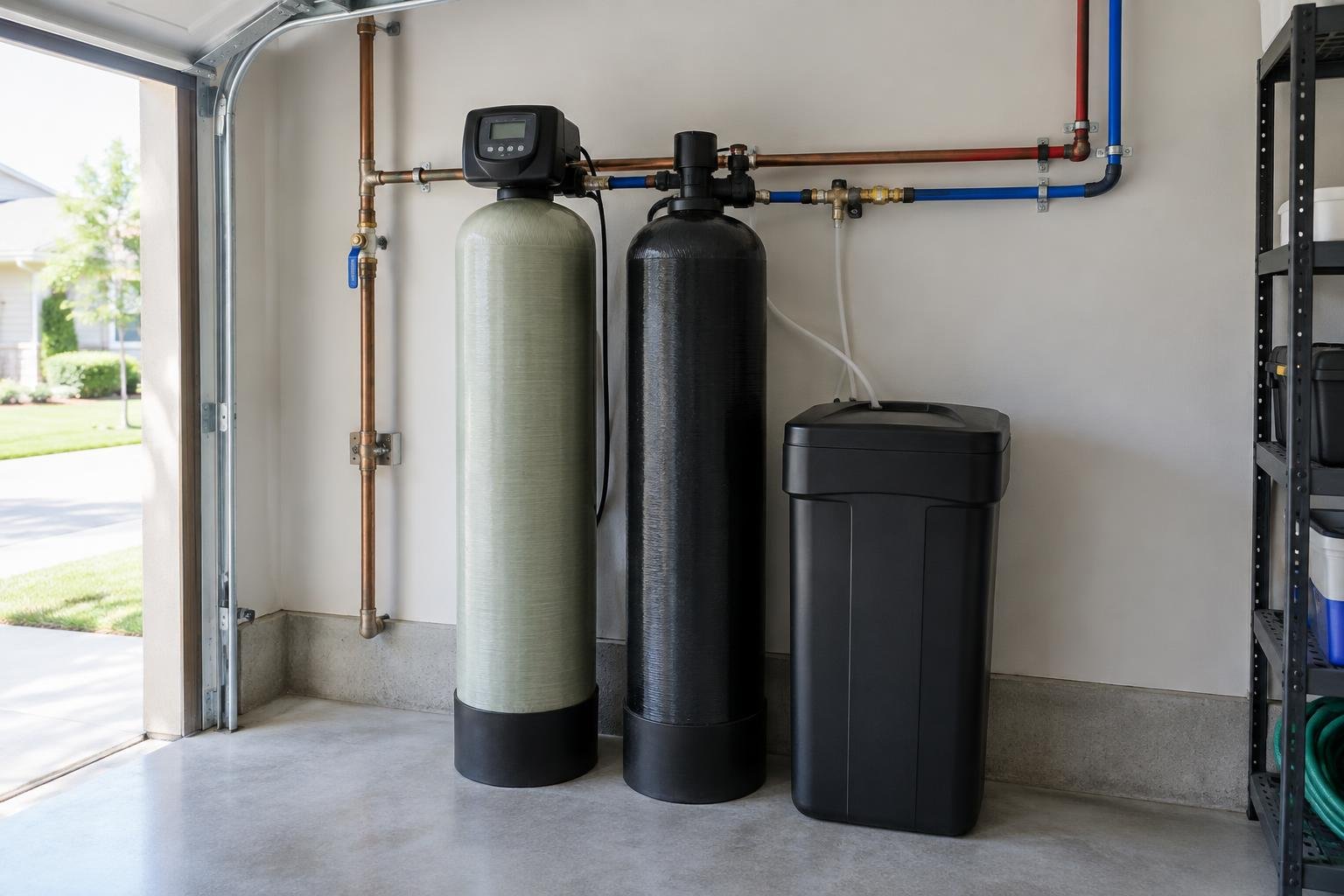
If your glassware comes out of the dishwasher cloudy, your shower door grows a white film within days, and the tap has a faint swimming-pool smell, you already know the basics of North Texas water. This guide covers whole house water filtration in Dallas the way a homeowner actually needs it: what's in the water, which equipment fixes which problem, what it costs installed, how to size it, and what you have to maintain afterward.
No sales pitch. Just the decisions, in order.
Start with the good news. Dallas water is treated, tested, and delivered to federal and state drinking-water standards. The issues most homeowners notice aren't safety failures — they're nuisance issues that treated surface water carries into the house.
Dallas and most surrounding North Texas cities draw from area lakes and reservoirs. Surface water like that tends to bring three things with it:
Your exact numbers depend on which plant serves your address, the season, and the age of the pipe in your street. Two houses ten minutes apart in Dallas can test differently. That's why the honest starting point is testing your own water, not reading a city average.
A whole-house (point-of-entry) system installs where the main water line enters your home, usually in the garage or near the exterior wall by the water heater. Everything downstream gets treated water: every faucet, every shower, the washing machine, the ice maker, the water heater.
That's the advantage over a pitcher or a single under-sink filter. You're not just improving the water you drink. You're protecting the appliances and the plumbing, and you're changing what your skin and clothes are washed in.
What a whole-house system is not is a single magic tank. Different problems need different media. Here's what each piece does.
A replaceable cartridge that catches silt, grit, and rust flakes. It protects the equipment behind it. Cheap, simple, and the first stage in almost every well-designed setup.
The workhorse for taste and odor. Carbon media adsorbs chlorine, chloramine byproducts, and many organic compounds that cause that chemical smell. For chloramine specifically, catalytic carbon handles it far better than standard carbon — an important spec to ask about in Dallas, because the wrong media gets used up fast.
Removes or reduces: chlorine taste and smell, chloramine, many volatile organic compounds, some pesticides and industrial chemicals.
Does not remove: hardness minerals, dissolved salts, nitrates.
The only equipment that truly removes hardness. Resin beads trade calcium and magnesium for sodium or potassium, and the unit rinses itself out on a schedule using salt from a brine tank. Soft water means no new scale in the water heater, less soap scum, and shampoo and detergent that actually lather.
Removes: calcium, magnesium, some dissolved iron.
Does not remove: chlorine, taste and odor issues, sediment.
A conditioner doesn't remove hardness — it changes the minerals so they're less likely to stick to pipes and heating elements. No salt, no drain line, no backwash. Good fit for homes where a drain or a brine tank isn't practical, or where you'd rather not add sodium. You still see minerals in your water test; you just see less scale buildup.
Deciding between those two is the most common fork in the road. We walk through it in Whole House Water Filter vs Water Softener.
Reverse osmosis (RO) pushes water through a membrane fine enough to strip out dissolved solids, lead, nitrates, fluoride, and more. It's slow and it wastes some water, which is why it belongs under the kitchen sink rather than on the main line. Pair it with whole-house filtration and you get protected plumbing everywhere plus bottled-quality water at the tap you drink from.
Undersized equipment is the most common mistake we see on existing installs. A filter tank that's too small can't keep up when two showers and the washing machine run at once, so pressure drops and the media doesn't get enough contact time to work.
Sizing comes down to peak flow — the gallons per minute your home can demand at its busiest moment — and the number of people using the water.
Grain capacity should be matched to your measured hardness and your household's daily gallons, not guessed from square footage alone. That's a ten-minute calculation once someone has your test results in hand.
Pricing depends on your water test, the size of the house, and how your plumbing is laid out. Broad ballparks for professionally installed equipment in the Dallas area:
What moves the number: whether there's an existing loop at the main line, how far the nearest drain and outlet are, whether a pressure regulator or expansion tank is needed, and the grade of media and control valve you choose. A cheap valve is the part that fails first. For a fuller breakdown of each line item, see What Does a Whole House Water Filtration System Cost in Dallas?.
Most Dallas installs are a half-day job. Water gets shut off at the main, the installer cuts in a bypass loop so the system can be serviced without killing water to the house, sets the tanks, runs a drain line if the equipment backwashes, and programs the control head to your hardness. Permits and plumbing code requirements vary by city, so ask who's pulling them.
Garage installs are the norm here because so few Dallas homes have basements. If your main line enters on the far side of the house from a drain, say so early — it changes the plan and the price.
Skipping maintenance doesn't make the water unsafe — it makes the equipment you paid for stop doing its job quietly.
Every recommendation above hinges on one thing: what's in your water. Hardness, chlorine or chloramine levels, iron, and total dissolved solids vary across the metroplex and even street to street.
H2O Clarity by US Home Comfort is our water-quality program, and it starts the same way for every Dallas homeowner: a free water report. We test what's coming out of your tap, explain the results in plain English, and size equipment to your actual numbers and your actual household.
If you've been putting up with scale, dry skin, and that chemical smell because you weren't sure what would fix it, that's the step that turns guesswork into a straight answer. Request your free Dallas water report and we'll go from there.