
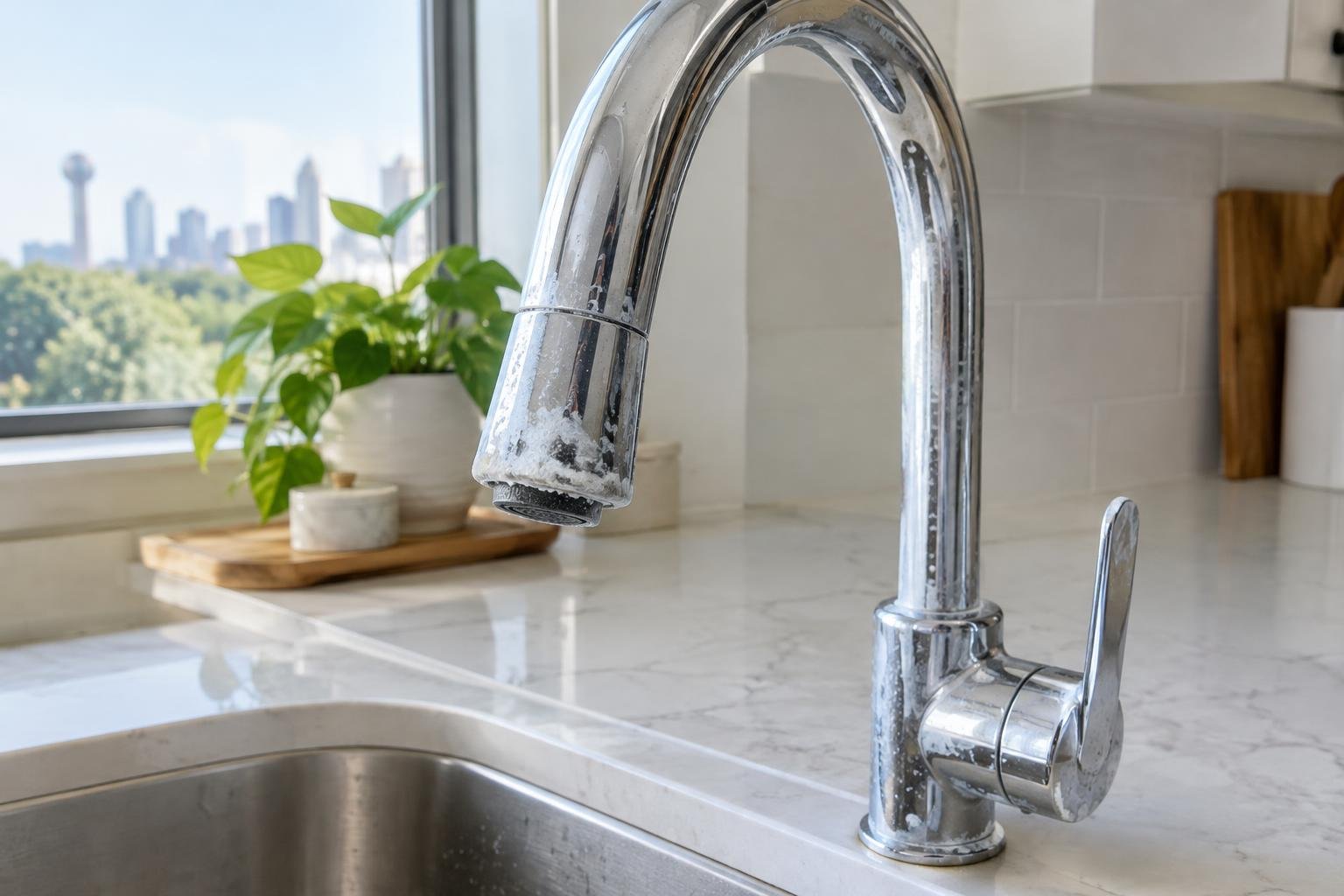
Dallas water hardness is not a single number. It changes depending on which utility treats your water, which lake that water came out of, and whether your neighborhood is on surface water or a well. Two homes fifteen minutes apart can get noticeably different water — one leaves spots on the glassware, the other crusts up a water heater in a few years.
This is a plain-English breakdown of what hardness readings mean, how they tend to differ across Dallas and the surrounding suburbs, and which homes feel the effects hardest. If you want the broader background first, start with our straight answer on whether Dallas has hard water, then come back here for the area-by-area view.
Hardness is just a measure of dissolved calcium and magnesium in your water. More minerals, harder water. It is not a health hazard — it is a plumbing and appliance problem.
You will see hardness reported two ways:
To convert, divide mg/L by 17.1 to get grains per gallon. So 120 mg/L is about 7 grains.
The U.S. Geological Survey uses these general classifications:
Here is the part that matters for a homeowner: anything in the "hard" range and up will leave visible scale, shorten the life of a water heater, and make soap behave badly. Most of North Texas sits at moderately hard or harder.
People search for hardness by neighborhood, but neighborhoods don't treat water. Utilities do. In the Dallas area, a handful of systems cover most homes, and your address determines which one you're on.
Dallas pulls from surface reservoirs — lakes, not wells. Surface water in this region carries a real mineral load, but it is generally less mineralized than groundwater. Dallas water typically lands in the moderately hard to hard range, and it moves around a little through the year as the city blends water from different lakes and as rainfall changes what's in them.
That means Preston Hollow, Lakewood, Lake Highlands, Oak Lawn, Oak Cliff and the rest of the city are all on essentially the same supply. If someone in Preston Hollow has worse scale than someone in Oak Cliff, the difference is almost always the house, not the water main. More on that below.
Highland Park, University Park and a number of nearby cities buy treated water wholesale from Dallas. Their hardness tracks closely with the City of Dallas, with small differences from distribution and storage.
Plano, Frisco, McKinney, Allen, Richardson, Garland, Rowlett, Wylie and Rockwall are largely served by the North Texas Municipal Water District, which also uses surface reservoirs. Readings in these cities commonly fall in the same moderately hard to hard band as Dallas, but they are a separate system with their own blend, so the exact number differs — sometimes noticeably from one year to the next.
Fort Worth, Arlington and surrounding cities draw from a different set of reservoirs. Same story: surface water, moderate-to-hard range, with its own seasonal swing.
This is the real dividing line in Dallas-Fort Worth. Outlying parts of Denton, Collin, Ellis, Kaufman, Johnson and Parker counties — plus small water supply corporations, municipal utility districts and private wells — often rely on groundwater from the Trinity aquifer. Groundwater has spent a long time sitting in rock, and it tends to come out harder and more mineralized than lake water.
If you moved from a City of Dallas address to a home on a rural water supply corporation or a private well, and suddenly your shower doors fogged over in a month, that's why. Well homes also deal with iron and sulfur that city customers rarely see.
The short version of Dallas water hardness by area: most of the metro's city water is moderately hard to hard. The outlying groundwater areas are usually harder. Nobody in North Texas gets soft water out of the tap.
Hardness is identical up and down the street. What's different is the house. These factors decide how much you notice it:
If you're trying to decide whether your numbers are a problem, look for the symptoms instead of the statistics:
None of this makes the water unsafe to drink. It makes the house more expensive to run and less pleasant to live in.
For a deeper look at the readings and what's in the water besides minerals, see how hard Dallas water really is.
The fix depends on the problem you're solving, and these two are not the same thing:
Plenty of Dallas homes genuinely need both, which is why they're often installed together at the main line where water enters the house. If you're weighing it up, our comparison of a whole house water filter versus a water softener walks through which one solves which complaint, and our Dallas water filtration cost guide covers what the equipment and installation actually run.
Averages are a starting point. Your house has its own answer, shaped by your utility, your plumbing and your water heater. Find out what you're working with before you buy anything.
H2O Clarity by US Home Comfort tests Dallas-area homes and explains the results in plain language — what's in your water, what it's doing to your fixtures, and whether you need treatment at all. Book your free water report and get a number you can act on.