
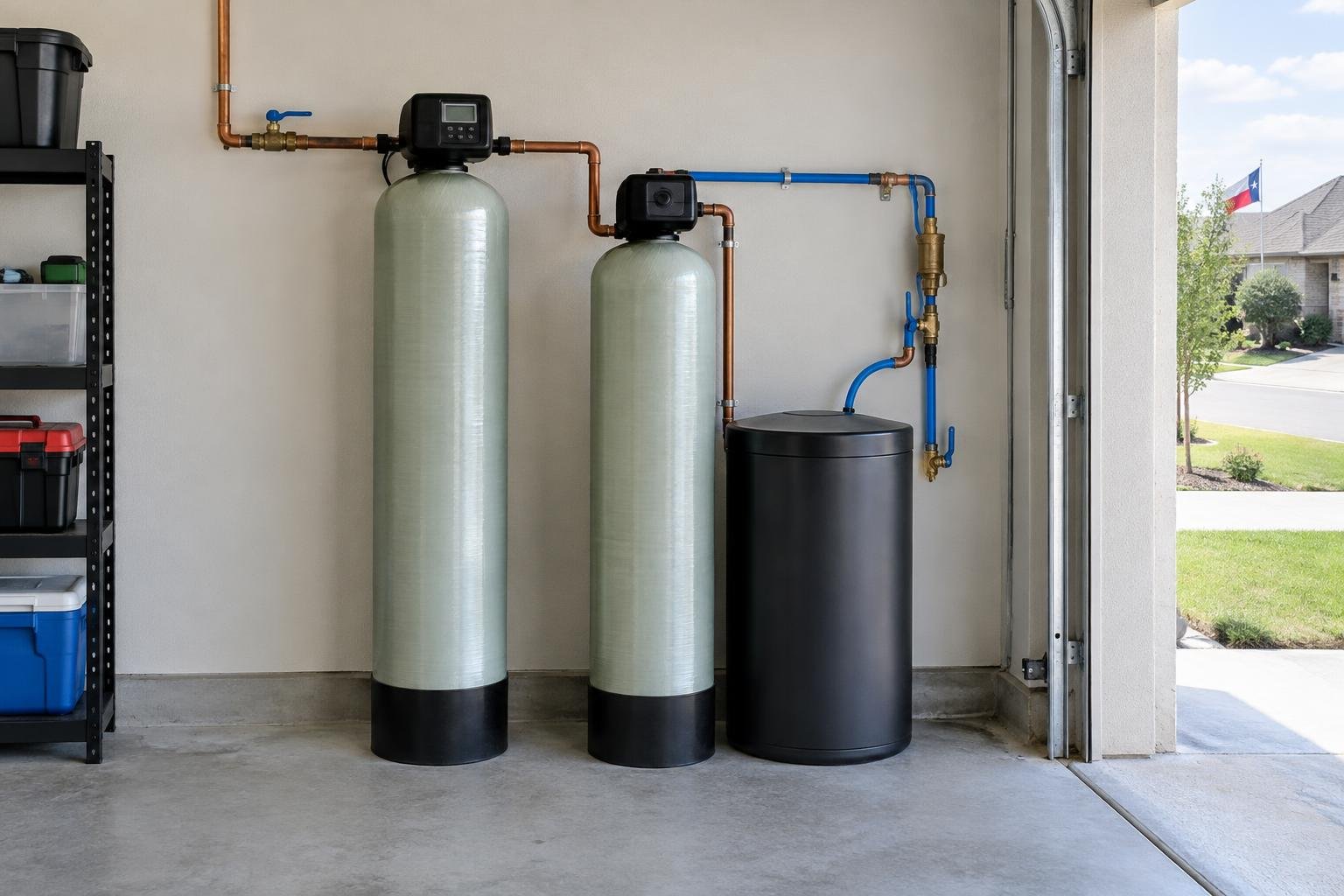
Walk into a Dallas garage with a finished water treatment job in it and you will usually see the same thing: two tanks standing side by side against the wall where the main water line comes in, with a short run of pipe connecting them. That pairing is what people mean when they ask about a water filter and softener combo in Dallas. One tank handles what is dissolved in your water. The other handles what your water is made of. Neither one does the other's job, which is why North Texas homes so often end up with both.
Here is what each unit actually does, why they are plumbed in the order they are, how much garage wall you need to give up, and what the whole thing costs installed.
A whole-home filter treats everything the water picked up on the way to your house — at the treatment plant and across miles of distribution pipe after it. The Clarity Whole Home Filter we install is rated to reduce chlorine and chloramine (the disinfectants that make tap water smell like a swimming pool), volatile organic compounds, PFOS and PFAS — the "forever chemicals" that do not break down in the environment — along with lead and mercury. It is a four-stage unit with a one-million-gallon capacity and a five-year limited warranty.
Two things about it matter for the garage. It is self-cleaning upflow, which means it rinses its own media bed by reversing the water through it. And it needs no electricity, no salt and no drain connection. That makes it the easy half of the install: it is essentially a tank plumbed inline.
If you want the detail on what that filtration removes and why a pitcher does not, we covered it in PFAS in Dallas tap water and why Dallas tap water smells like a swimming pool.
Hardness is not a contaminant. It is dissolved calcium and magnesium, and no carbon filter removes it. Taking it out requires ion exchange: water passes through a bed of resin beads that trade the hardness minerals for sodium. Once the bed fills up with hardness, it has to be recharged. As Nebraska Extension describes the process, the resin is flushed with a salt brine solution to regenerate it; Penn State Extension describes the same backwash with a salt solution during that cycle.
That is why the softener is the demanding half of the pair. It is two pieces, not one — a tall resin tank and a shorter brine tank that holds the salt — and it needs a drain for the regeneration water and, on most units, power for the control valve.
Dallas Water Utilities reports average hardness in the range of roughly 140 to 160 milligrams per liter, which works out to about 8 to 9 grains per gallon. A grain per gallon is just the standard unit for dissolved hardness minerals; anything above 7 is classified as hard water. So the typical Dallas house is not borderline. It is solidly in the range where scale builds in the water heater, shower glass stops coming clean and soap stops lathering.
At the same time, that water is disinfected with chloramine and arrives through old distribution pipe. So you have two separate problems arriving in the same line.
If you are still deciding whether you need one or both, start with our side-by-side comparison of a whole house filter and a water softener, or run the ten-minute checks in do I need a water softener in Dallas.
Water moves through a combo system in one direction, and the sequence is deliberate:
A few routing decisions get made on site. Outdoor hose bibs and irrigation are typically left ahead of the system, because there is no reason to soften water for the lawn or to run through treatment capacity watering shrubs. A reverse osmosis unit, if you want one for drinking and cooking, goes at the kitchen sink downstream of everything else — we explained where that fits in whole house filter or reverse osmosis.
Less than most people picture, but it is not nothing. Plan on a stretch of wall near where the main line enters, usually the garage in a Dallas slab-on-grade house. You need room for three tanks in a row — filter, softener resin tank, brine tank — plus space to stand in front of the control valve to service it and enough clearance above the brine tank to tip a bag of salt in.
The other requirements are easy to miss until install day:
In a garage where the main line is awkwardly placed, the run of pipe gets longer and the job takes more time. That is the single biggest variable in how an install day goes.
A licensed Texas plumber does the work. Water comes off at the main, the line is cut and tied into the new loop, both units are set, the drain and power are connected, and the system is flushed and programmed for your home's hardness. Then the water comes back on and the plumber walks you through the bypass valves and the salt.
Sizing is done before anyone shows up, based on how many bathrooms you have and how many people live there, so the softener is not regenerating constantly or running out of capacity in the middle of morning showers. That sizing logic is laid out in our complete guide to whole house water filtration in Dallas.
Day to day, the filter asks nothing of you. The softener asks for salt. How often depends on how much water the household uses and how hard the incoming water is — a bigger family regenerates more often and goes through more salt than a couple in the same neighborhood. Checking the brine tank when you take the trash out is enough of a routine.
The change you notice first is usually in the shower: soap lathers, hair rinses clean, and the glass door stops building the cloudy film that never fully scrubbed off. The change you do not see is on the water heater element, where scale is no longer forming. We wrote about that one in hard water and your water heater.
Our filter plus softener combo systems are $7,500 to $9,500 installed, sized to the home and put in by a licensed Texas plumber, with financing available. The range reflects the home — bathroom count, household size, and how much plumbing work it takes to tie into your particular main line.
That is an installed price, not equipment on a pallet. It covers the sizing, the plumbing, the valves and the startup. If you are comparing quotes from several companies, the thing to check is whether the number you are being given includes the install and the right capacity for your house, or just the boxes. Our breakdown of what drives whole house water filtration cost in Dallas goes through what to look for line by line.
There is no sense buying a filter for contaminants that are not in your area's water, or sizing a softener against a hardness number from a different city. Hardness and water chemistry shift across Dallas-Fort Worth depending on which source and which district serves you.
So start with the free water report. Enter your address and we pull your area's real water-quality data into a clear report: what has been detected, how it compares to health guidelines rather than just legal limits, and what that means for the equipment your house actually needs. It is free, it is specific to your address, and it costs you nothing to look.
Get your free water report from H2O Clarity by US Home Comfort and see what is coming out of your taps before you spend a dollar on equipment.